
Take charge of
your sleep
FDA-cleared and clinically-validated
A New Way to Fight Insomnia
Insomnia is the most common sleep disorder among adults worldwide. Various studies show that insomnia may be prevalent in 10-60% of the population. Insomnia is often the result of underlying causes such as high stress or anxiety, depression, certain medications, or other health conditions.
And because insomnia can negatively impact mental and physical well-being, we developed Alpha-Stim® to provide a drug-free treatment option that’s safe and easy to use at home.
Clinically Proven to Relieve Insomnia
Alpha-Stim is an FDA cleared CES medical device that is clinically proven to treat insomnia and safe to use at home.
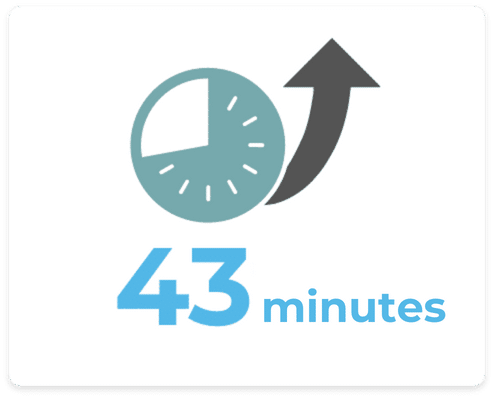
INCREASED SLEEP TIME
After only 5 treatments, military Service Members with insomnia reported an increase of 43 minutes of sleep.1
IMPROVED SLEEP QUALITY
In one study, the number of subjects rating their quality of sleep as poor dropped from 60% to 5% after using Alpha-Stim CES therapy.2
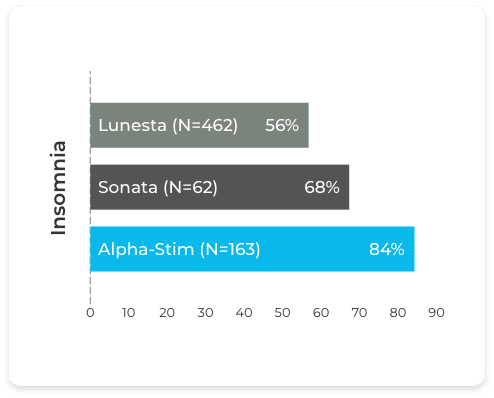
Preferred Over Medication
Also Treats Anxiety
Alpha-Stim is also designed to treat anxiety, providing patients with simultaneous anxiety and insomnia relief.
How Does Alpha-Stim Treat Insomnia?
Alpha-Stim is an FDA cleared CES medical device used to treat insomnia and improve overall sleep quality using an exclusive, patented waveform technology. This revolutionary waveform passes between two electrodes clipped to your earlobes to help restore balance in your brain and thereby reduce disrupted sleep.
Alpha-Stim can be used between 20 minutes and 1 hour, daily, and over time, treatments can be decreased to 2-3 times per week as results improve. And because the effects of Alpha-Stim build on the progress of the last session, many Alpha-Stim users see increased levels of relief over time. Moreover, because CES does not involve any chemicals, Alpha-Stim users are free from the worry of dependence and withdrawal.
What People Say About Alpha-Stim for Insomnia
See what people are saying about using Alpha-Stim for treating insomnia and improving sleep quality.
Get a better night’s sleep.
Schedule a telehealth consult today with a licensed health care provider to give Alpha-Stim a try.
Commonly Asked Questions about Insomnia
We’ve gotten a few questions over the years about sleep disorders, and especially insomnia. Below are a few with answers from professionals.
*Please consult with a physician for medical advice. The information below does not replace medical advice received by physician.
Why do I feel tired and low on energy all day, but when I go to bed I can’t sleep?
If you’re feeling tired all day, you’ve likely been tempted to either double down on your caffeine intake or take a nap. Though it may seem counterintuitive, a recent article from Harvard recommends avoiding napping, as it can ruin your body’s “appetite” for sleep later at night. Caffeine consumption can likewise prevent your body from entering a restful state, even hours later.
Try to stick to a schedule – even if it’s different from your “normal” routine. Waking and going to bed at the same time each day can help your body get into a groove. It doesn’t matter if your new schedule looks completely different from what it used to; what matters is consistency.
I can fall asleep, but it’s not restful, and I keep waking up. What can I do?
Our bodies are wired to stay awake when we feel threatened, according to Janet Kennedy, PhD, founder of NYC Sleep Doctor. “Our bodies are misfiring,” she says, making it impossible for us to stay asleep. Dr. Kennedy recommends getting out of bed when this happens – watch a TV show, work on a puzzle, do some dishes. Waiting to go back to sleep will only make you frustrated.
If insomnia is an ongoing issue for you, treatments with Alpha-Stim can bring you better quality, longer sleep. Treatments take just 20 minutes to an hour and are done in the comfort of your own home. Getting better sleep will help you be better prepared for the next day.
Does insomnia trigger sleep apnea or vice versa?
The American Sleep Foundation says sleep apnea and drugs prescribed to remedy other medical conditions are among the causes of insomnia.
Alpha-Stim for insomnia treatment is ideal in these situations because it offers insomnia relief and better sleep habits without medication.
Does Alpha-Stim really work for insomnia?
Alpha-Stim has been proven effective at treating insomnia through clinical evidence spanning decades of research (studies, clinical trials, and more). With Alpha-Stim, we routinely hear about how it’s helping people sleep longer, get better quality sleep, works better than common medications like melatonin, and is also helping reduce anxiety.
Some people find immediate relief with Alpha-Stim for insomnia, while some may need a few weeks to notice a significant improvement in sleep quality and duration.
Is Alpha-Stim a VNS device?
No. Alpha-Stim is a CES device. Due to the similarity in using an electrical current or earclip electrode application, Alpha-Stim can commonly be misidentified as a VNS device or auricular vagus nerve stimulation (aVNS) devices. And while Alpha-Stim does interact with the vagus nerve, there are key differences in the types of stimulation Alpha-Stim utilizes and the brain regions it targets.
Does Alpha-Stim Stimulate the Vagus Nerve?
Yes.
Alpha-Stim isn’t specifically designed to target the vagus nerve like dedicated vagus nerve stimulation (VNS) devices. However, its cranial electrotherapy stimulation (CES) does engage neural pathways that include vagal function (the vagus nerve), which may contribute to some of the clinical benefits seen with the device.
To better understand how Alpha-Stim works, Ryan Gober, PhD, the Medical Science Liaison at Electromedical Products International, explains:
“Alpha-Stim uses a low intensity, patented waveform delivered through bilateral earclip electrodes to modulate cortical activity in the temporal lobe of the brain and to stimulate nearby key cranial nerves, including the vagus, trigeminal, and vestibulocochlear nerves that project to deeper subcortical brain structures. Through these two synergistic mechanisms, Alpha-Stim has been shown to modulate activity in the default mode network (DMN), which is widely reported to exhibit altered connectivity in a number of mental health conditions, including anxiety and insomnia.”
Do I need both Alpha-Stim and a VNS device?
The short answer? No. See why below.
VNS devices are designed specifically to target the vagus nerve, whereas Alpha-Stim works in a broader capacity through cranial electrotherapy stimulation (CES) delivered via the earlobes. This approach interacts with vagal pathways along with other cranial nerve networks, which is part of why Alpha-Stim is FDA-cleared for the treatment of anxiety, insomnia, and pain only, with approval for depression outside of the United States.
To better understand how Alpha-Stim works, Ryan Gober, PhD, the Medical Science Liaison at Electromedical Products International, explains:
“Alpha-Stim uses a low intensity, patented waveform delivered through bilateral earclip electrodes to modulate cortical activity in the temporal lobe of the brain and to stimulate nearby key cranial nerves, including the vagus, trigeminal, and vestibulocochlear nerves that project to deeper subcortical brain structures. Through these two synergistic mechanisms, Alpha-Stim has been shown to modulate activity in the default mode network (DMN), which is widely reported to exhibit altered connectivity in a number of mental health conditions, including anxiety and insomnia.”
Does Alpha-Stim interact with the vagus nerve?
Vagus nerve stimulation (VNS) and VNS devices are often promoted for improving mood, emotional regulation, depression, and pain.
Alpha-Stim does interact with the vagus nerve, but there are key differences in the types of stimulation Alpha-Stim utilizes and the brain regions it targets.
- Alpha-Stim delivers its patented cranial electrotherapy stimulation (CES) waveform through small clips on both earlobes. While the stimulation begins at the ear, the resulting electric fields extend beyond the clip sites to influence nearby cranial nerves, including the auricular branch of the vagus nerve.
- What sets Alpha-Stim apart from a VNS device is that its fields don’t stop at the nerves outside the skull; they also pass through the bone to reach cortical layers of the brain. This direct brain engagement allows Alpha-Stim to modulate activity in brain regions such as the temporal lobe and in broader brain networks that are often dysregulated in anxiety and insomnia.
- By influencing both cranial nerves and cortical circuits, Alpha-Stim offers a distinct mechanism that helps normalize signaling in functional networks tied to these conditions.
Is Alpha-Stim better for anxiety than a VNS device?
Regulatory authorization differs across VNS and non-VNS devices. Alpha-Stim is FDA-cleared (Class II) with defined, labeled indications, whereas other non-invasive products are often marketed in the United States solely as general-wellness devices (GWDs) and are not cleared to treat medical conditions. Alpha-Stim CES is cleared for the treatment of anxiety and insomnia, and Alpha-Stim M’s MET technology is cleared for pain management.
In practical terms, FDA clearance means the device has been reviewed in accordance with applicable regulatory requirements for specific medical indications, and the manufacturer has provided supporting evidence—including performance testing and clinical data—demonstrating that the device meets FDA expectations for safety, performance, and labeling. In contrast, general wellness products are not reviewed or cleared by the FDA for specific medical claims or indications.
Always verify each device’s clearance, labeling, and supporting evidence when choosing a treatment option.
As such, Alpha-Stim offers a unique combination of mechanistic overlap with vagus nerve–targeting devices and the regulatory assurance of FDA clearance for clinical use. (Outside the United States, Alpha-Stim is approved for treating anxiety, insomnia, and pain, as well as depression.)
In conclusion, clinical research suggests Alpha-Stim CES works via a multimodal mechanism involving indirect stimulation of the vagus nerve as well as cortical brain regions that have been linked to anxiety and insomnia.
Moreover, Alpha-Stim is evidence-based, with numerous clinical studies supporting FDA clearance to treat symptoms of anxiety and insomnia as reflected in the device’s labeling. This combined stimulation of cranial nerves and cortical brain regions, along with differences in regulatory authorization, distinguishes Alpha-Stim from devices focused solely on non-invasive VNS/aVNS.
Is Alpha-Stim the same as other CES devices?
No. Not all CES devices are the same. And this is why researching a device is critical. Below are some things that make Alpha-Stim stand out from other CES devices in the market:
- Alpha-Stim uses a patented waveform, making the stimulation it uses distinct from other CES devices.
- Decades of clinical evidence demonstrates safety and long-term efficacy.
- Alpha-Stim delivers cumulative results that build over time for long-lasting anxiety, insomnia & depression* relief.
- Alpha-Stim stimulates the brain to normalize the pathological signaling in the default mode network that is observed in psychiatric disorders, providing rapid, effective, and lasting symptom relief without the side effects of medication [In simpler terms, Alpha-Stim CES modulates the brain network associated with anxiety, insomnia, and depression to help bring it back to “normal”]
- Alpha-Stim also offers the ability to treat pain. This is another differentiator between other CES devices and Alpha-Stim.
TAKE CHARGE OF YOUR LIFE WITH ALPHA-STIM
telehealth
Visit
Featured Content
Dakota Meyers shares his experience with Alpha-Stim AID for battling his anxiety.
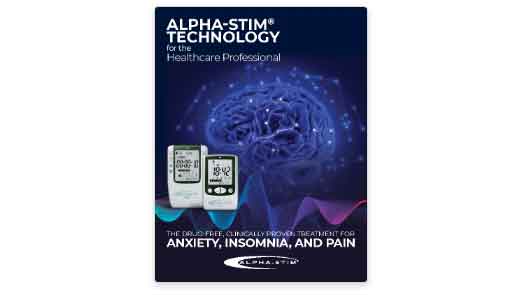
Get a quick overview of Alpha-Stim devices for use with patients.
A new way to treat insomnia is here, with no medications or lasting side effects.
Sources:
1Lande RG, Gragnani C. Efficacy of Cranial Electric Stimulation for the treatment of insomnia: A randomized pilot study. Complementary Therapies in Medicine. 2013; 21(1):8-13.
2Lichtbroun AS, Raicer MMC, Smith RB. The treatment of fibromyalgia with Cranial Electrotherapy Stimulation. Journal of Clinical Rheumatology. 2001; 7(2):72-78.
3Kirsch, D.L., Price, L.R., Nichols, F., Marksberry, J.A., & Platoni, K.T. Military Service Member and Veteran Self-Reports of Efficacy of Cranial Electrotherapy Stimulation for Anxiety, PTSD, Insomnia, and Depression. (2014). The Army Medical Department Journal, 46-54.